Here’s the truth about law school: you learn IRAC in the first week, and you probably never connect it to case briefing. Your professor introduces Issue, Rule, Application, Conclusion as an exam-writing framework, and you memorize it for tests. But what if IRAC isn’t just for exams? What if it’s also the simplest, most reliable way to brief a case? It is.
IRAC is the most widely taught analytical framework in law school — and it’s directly applicable to case briefing. In fact, case briefs are the easiest version of IRAC because you’re not generating analysis from scratch. You’re extracting what a court already wrote. Your job is to identify the issue the court addressed, pull out the rule it applied, and understand its conclusion. That’s it.
Quick Facts
- IRAC stands for Issue, Rule, Application, Conclusion
- Case briefs extract IRAC from a court opinion — they’re the easiest version of the framework
- The same four elements work for case briefs, exam essays, and legal memos — only the order shifts
- 60% of exam points live in the Application section (and most students skip it)
- Start with case briefs to build your IRAC skill before exams force you to generate it from scratch
What Is the IRAC Method?
IRAC is a four-part structure for legal analysis: Issue, Rule, Application, and Conclusion. Every law school teaches it because legal analysis isn’t free-form writing — it’s a predictable sequence of four specific moves. A judge, a partner reading a memo, or an exam grader needs to see those four things in order: what question is being asked, what law governs it, how the law applies to these facts, and what the answer is.
The framework exists to make legal analysis visible. Without it, two students could write equally correct answers in radically different orders and a reader would have to reconstruct your thinking. With it, every answer reads the same way and the reader can quickly verify each element is present.
IRAC is taught as early as the first week of law school because it standardizes legal reasoning. That’s why you’ve heard it everywhere — and that’s also why you’ve never seen it explicitly connected to case briefing. Most professors introduce IRAC as an exam-writing tool and move on. But the four elements work just as well — and just as powerfully — for reading a judicial opinion and extracting its structure.
Here’s what each section means:
- Issue — The specific legal question the court is answering. Frame it as a “yes or no” question that connects the facts to the law.
- Rule — The legal principle the court applied. Write it in portable, fact-free terms — a rule that works for any case, not just this one.
- Application — The reasoning that walks the facts through each element of the rule. This is where most exam points live.
- Conclusion — The court’s answer. One sentence. Decisive. No hedging.
The diagram below shows how IRAC flows as a complete analytical structure.
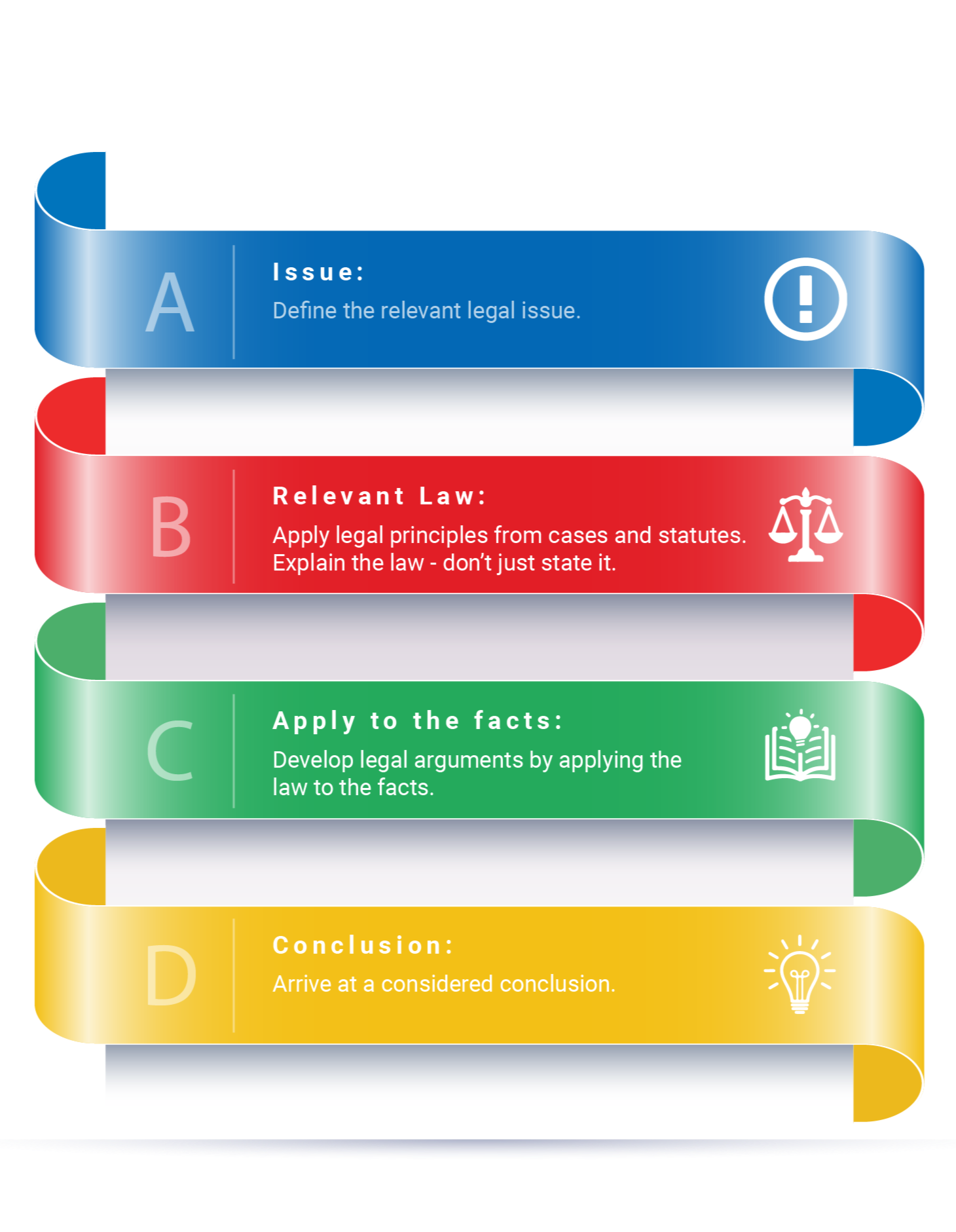
Diagram: Case Cub / IRACMethod.com (Wix)
IRAC vs. the 8-Section Case Brief: How They Map to Each Other
You might already know the standard case brief format — the 8-section template your professors require. Here’s how IRAC maps onto that structure:
| 8-Section Case Brief |
IRAC Equivalent |
What Goes Inside |
| Facts |
Background for Application |
Only the legally relevant facts that matter to the rule |
| Issue |
Issue |
The “yes or no” question the court answered |
| Rule of Law |
Rule |
The black-letter law stated portably (without case facts) |
| Holding |
Conclusion |
The court’s direct answer applied to these facts |
| Reasoning |
Application |
How the court connected the rule to the facts |
Think of the Reasoning section from your existing case brief — that’s the “A” in IRAC. As the American Bar Association notes, “Think of the Reasoning section as the ‘A’ in IRAC. In law school exams, the ‘Application’ is where you take the rule of law and apply it to the specific facts in the problem.” But you don’t need a new framework to do case briefing. You already have IRAC. You’re just extracting instead of generating.
This is the crucial distinction: case briefing is IRAC extraction. Exam writing is IRAC generation. In a case brief, the court has already done the work — it framed the issue, stated the rule, and reached a conclusion. Your job is to identify each element and write it down. On an exam, you do the exact opposite: you spot the issue from a blank fact pattern, recall the rule from memory, apply it to new facts, and conclude. The four elements are identical. The generative direction is opposite.
If you’re new to IRAC, start with case briefs. Extracting IRAC from a judicial opinion is the easiest version and builds the skill you’ll need when you generate IRAC from scratch on exams.
The Four Elements of IRAC, Step by Step (for Case Briefing)
Each letter in IRAC represents a specific move. Understanding what belongs in each section — and what doesn’t — is the entire skill of case briefing.
Issue: What Question Did the Court Answer?
The issue is the legal question the court must resolve. It should be specific enough that a reader who has never seen the case knows what the law is being asked about, but not so fact-specific that it can’t be applied to other cases.
A good issue reads as a question. It connects the facts to the law. On exams, spotting every issue is the highest-leverage skill — missed issues are missed points. For case briefs, the issue is already framed by the court. Your job is to extract it accurately.
What a good Issue looks like: “Does a manufacturer owe a duty of care to a consumer who is not the original purchaser?”
What a bad Issue looks like: “Was the defendant liable?” — too general to be useful.
What a bad Issue looks like: “Whether the court erred in granting summary judgment.” — procedural, not substantive.
Here’s a technique Case Cub recommends: when drafting your issue for an exam, “spot every issue the fact pattern raises — missed issues are missed points.” For case briefs, this translates to carefully reading the court’s opinion and ensuring you’ve captured every distinct legal question the court addressed. Many opinions raise multiple issues — a negligence case might address duty, breach, causation, and damages as separate questions. Each one gets its own issue statement.
As Case Cub explains, do not restate the entire fact pattern. The issue should not be so general that it could apply to any case. It should be specific enough that the rule’s elements are visible in the question itself. The issue should read like a “yes or no” question that connects the facts of the dispute to the law in question — a principle that applies equally to case briefing and exam writing.
Rule: What Law Governed the Decision?
The rule of law is the governing legal principle the court applied. Write it in black-letter law terms — clear, general, fact-free. A rule should be portable: it should work for any future case with similar legal issues, not just this one.
Here’s the critical rule: don’t embed facts in the Rule. Writing “the railroad owed no duty because Mrs. Palsgraf was on the platform” is a Holding masquerading as a Rule. A clean Rule says: “A defendant owes a duty of care only to those whose injuries are reasonably foreseeable from the defendant’s conduct.”
This distinction between Rule and Holding is one of the most important skills in legal analysis. The Rule is the general principle. The Holding is the specific application of that principle to the facts of the case. Confusing the two — writing the rule with case-specific facts inside it — is the single most common mistake new law students make. If you write the rule with case-specific facts inside it, you’ve blurred the line between rule and analysis.
Case Cub emphasizes three do’s for Rule statements:
- State the rule in portable form — without case-specific facts
- Include all elements — mens rea, actus reus, intent, foreseeability — so you can apply each one later
- Cite the source — Restatement, case, or statute
And three don’ts:
- Don’t write a fact-bound conclusion masquerading as a rule
- Don’t omit elements you’ll need in Application
- Don’t pad with rules that don’t bear on the issue
As the ABA emphasizes, “The rule section should be written in blackletter law terms — a clear and general statement of law — without tying it to any specific facts from the case.” The rule should be a template you can apply to any future case with similar legal issues. If a rule mentions “Mrs. Palsgraf” or “the railroad” or “the platform,” you’ve written a Holding instead of a Rule.
Application: Walk the Facts Through Each Element
This is the heart of IRAC. The Application section walks each element of the rule through the facts of the case, identifying which facts satisfy (or fail to satisfy) each element. It also acknowledges counterarguments — what the other side would say, and why the rule still favors one position.
This is where most exam points live.
Law School Toolbox’s research shows that writing time should be distributed roughly 10% Issue, 20% Rule, 60% Application, 10% Conclusion. Most failing exams “flip Rule and Application” — students write long Rule statements and short Application, then end up with the right law but no analysis.
Here’s the practical technique for Application writing: for each element of the rule, identify the specific fact that satisfies (or fails to satisfy) it. Don’t restate the rule. Don’t restate the facts as a narrative. Instead, walk each element through the facts — “here, the defendant’s knowledge of the spilled water satisfies the actual-notice prong” — using concrete facts to show how the rule applies. Use “because” statements to connect facts to legal elements. Make it impossible for a reader to connect the dots yourself — do the connecting.
A common 1L mistake is to restate the rule as a narrative or to restate the facts without analyzing them. Don’t just tell what happened. Tell how the facts satisfy each element of the rule. If you find yourself transcribing a paragraph of the opinion, stop and ask: “Does this fact change the outcome?” If not, move on. Your Application should be tight, focused, and fact-specific — not a summary of the case.
Conclusion: Lock the Analysis in One Sentence
The Conclusion is the court’s direct answer to the Issue. It should be one sentence. Decisive. No hedging. If the rule favors one side, conclude in that direction. Even when the answer is genuinely close, write a definite conclusion and note the counterargument as a parenthetical.
“It depends, but maybe” is not a Conclusion. Apply the rule, identify the strongest argument, and conclude in that direction. As Law School Toolbox advises, “Don’t hedge — if the rule favors one side, conclude in that direction.” Even when the answer is genuinely close, state your best prediction and explain why.
Worked Example: Briefing Palsgraf v. Long Island Railroad Using IRAC
Let’s extract IRAC from a famous case. Palsgraf v. Long Island Railroad Co., 248 N.Y. 339, 162 N.E. 99 (1928) is the textbook case for foreseeability in negligence law and the limits of duty.
Issue: Does a defendant owe a duty of care to a plaintiff whose injury was not a foreseeable consequence of the defendant’s conduct?
Rule: A defendant’s duty of care extends only to those plaintiffs whose injuries are within the foreseeable zone of danger created by the defendant’s conduct.
Application: The facts — a passenger carrying a package wrapped in newspaper jumped to board a moving train. Railroad employees pushed him aboard. The package fell, exploded (it contained fireworks), and the shockwave knocked down scales at the other end of the platform that struck Mrs. Palsgraf. Nothing in the package’s appearance suggested it was dangerous. Cardozo reasoned that negligence requires breach of a duty owed to the specific plaintiff harmed — not breach of a general duty to the world. The package gave no notice of danger. Without a foreseeable risk to Mrs. Palsgraf, the railroad owed her no duty.
Conclusion: No. The railroad owed no duty to Mrs. Palsgraf because her injury was not a reasonably foreseeable consequence of the conductor’s push.
Notice how the Rule is stated in general terms — “a defendant’s duty of care” — not “the railroad owed no duty to Mrs. Palsgraf.” That’s the portable rule you can apply to future cases. The Court in this opinion ran about 8 pages. This IRAC extraction is roughly half a page. That’s the point.
Want to see more case brief examples in IRAC format? Browse our free case brief library or check our existing case brief guide for a full template covering all 8 sections. And if you’re curious about how structured writing translates across disciplines, our guide to philosophy essay structure shows how argumentative frameworks work in other fields too.
How IRAC Changes Across Three Formats (Same Elements, Different Contexts)
The same four IRAC elements serve three very different legal writing formats. What changes is not the content — it’s which sections expand, how the ordering shifts, and whether you’re generating or transcribing.
Case Brief: Extracting IRAC from an Opinion
When you read a judicial opinion, the court has already framed the issue, applied a rule, and reached a conclusion. Your job is to identify each and write them down. This is the easiest version of IRAC — you’re not generating, you’re transcribing.
When it applies: 1L doctrinal courses (Torts, Contracts, Property, Criminal Law). You’re reading a judicial opinion and need to identify the IRAC the court used.
The generative direction: extracting IRAC from what the court already wrote.
Exam Essay: Generating IRAC from Scratch
You’re handed a fact pattern and asked to apply the law you’ve learned. Issue-spotting becomes the highest-leverage skill — missed issues are missed points. Application becomes the longest section because that’s where points are awarded.
When it applies: Midterms, finals, and bar exams.
The generative direction: generating IRAC from a blank fact pattern.
Legal Memo: Predictive IRAC for a Client
Most legal writing programs use CREAC instead of IRAC — Conclusion first, so the partner reading the memo doesn’t have to scroll for the answer. The substance is identical to IRAC. The ordering is reader-focused.
When it applies: Legal writing courses, summer jobs, and clinic work.
The generative direction: generating IRAC with Conclusion placed upfront.
The takeaway: The four elements are universal in legal analysis. The order, the length of each section, and the generative direction shift with the audience. Once you can write IRAC for a case brief, you can write it for an exam essay; once you can write it for an exam essay, you can write it for a memo with a small reordering.
Common IRAC Mistakes That Cost Exam Points
Even experienced law students make these errors. Here are the seven most expensive ones, with practical guidance for each:
1. Skipping the Application Section
The single most expensive mistake. Most exam points live in Application, not Rule. If your IRAC goes Issue → long Rule → Conclusion, you’ve skipped the section the grader is most actively scoring. Don’t just tell what happened. Walk each element of the rule through the facts, fact by fact. The Application should be the longest section of your IRAC — Law School Toolbox’s research shows writing time should be distributed roughly 10% Issue, 20% Rule, 60% Application, 10% Conclusion.
2. Writing the Rule with Case-Specific Facts
A rule should be portable. “The court held the railroad owed no duty to Mrs. Palsgraf because she was far away” is a Holding masquerading as a Rule. The Rule should work for the next case. If you write the rule with case-specific facts inside it, you’ve blurred the line between rule and analysis. A clean Rule says: “A defendant owes a duty of care only to those whose injuries are reasonably foreseeable from the defendant’s conduct.”
3. Missing Issues
Spot every issue, including the ones that look like throwaways. Each missed issue is a multiple-points loss. On a 4-issue negligence fact pattern, spotting only 3 issues caps you at 75% before the grader looks at your analysis. Speed-read the fact pattern once for issues before starting to write. As Case Cub advises: “On exams, spotting every issue is the highest-leverage skill — missed issues are missed points.”
4. Hedging the Conclusion
“It depends, but the court could go either way” is not a conclusion. Apply the rule, identify the strongest argument, and conclude in that direction. Even when the answer is genuinely close, write a definite conclusion and note the counterargument as a parenthetical. Your professor wants to see that you can apply the rule decisively, even to close cases.
5. Restating Facts as a Narrative
The grader read the fact pattern; you don’t need to summarize it. Reference facts within Application as you walk them through rule elements — not as a standalone facts paragraph. Case Cub warns: “The grader read the fact pattern; you don’t need to summarize it. Reference facts within Application as you walk them through rule elements — not as a standalone facts paragraph.” Use “because” statements to connect facts to legal elements.
6. Using Headers for IRAC Sections on Exam Answers
Most professors don’t want “ISSUE:”, “RULE:”, “APPLICATION:”, “CONCLUSION:” headers on exam answers. The structure should be visible from the writing itself — issue stated as a question, rule announced, application worked through, conclusion stated. Headers can fragment the analysis and look formulaic. Your IRAC structure should emerge naturally from your prose. On case briefs, however, headers are standard and expected — that’s where they help organize the extraction.
7. One IRAC for the Whole Exam Instead of One Per Issue
Each separate issue gets its own complete IRAC. A negligence exam with duty, breach, causation, and damages should have four IRACs, not one giant IRAC with all the rules stacked in the middle. Separate IRACs make it easier for the grader to award points per issue. “Each separate issue gets its own complete IRAC. A negligence exam with four issues (duty, breach, causation, damages) should have four IRACs,” explains Case Cub’s IRAC Method guide. This is a common structural mistake that inflates your writing time without earning extra points.
When to Use IRAC vs. FIRAC vs. CREAC vs. CRAC
Different forms of legal writing reorder the same elements for different audiences. The substance is identical. The sequencing is reader-focused.
| Format |
Stands For |
Best Used When |
Who Uses It |
| IRAC |
Issue, Rule, Application, Conclusion |
General 1L class briefing — the default format |
Most law schools, most professors, most casebooks |
| FIRAC |
Facts, Issue, Rule, Application, Conclusion |
Procedural-fact-heavy courses where posture matters |
Civil Procedure, Federal Courts, Complex Litigation |
| CREAC |
Conclusion, Rule, Explanation, Application, Conclusion |
Legal writing courses, predictive/persuasive memos |
Most legal writing programs; preferred by Quimbee |
| CRAC |
Conclusion, Rule, Application, Conclusion |
Persuasive writing — briefs and motions |
Upper-level legal writing, moot court, appellate practice |
Which one should you actually use?
- 1L Torts, Contracts, Property, Criminal Law: IRAC. It’s the universal default.
- 1L Civ Pro and Federal Courts: FIRAC. Procedural posture deserves its own section.
- Legal writing memos: CREAC. Your writing instructor is grading on this format.
- Persuasive briefs (moot court, appellate): CRAC. Lead with the conclusion.
IRAC is the default for case briefing because that’s what almost every law school expects. You’re briefing cases for class discussion — you don’t need to lead with a conclusion. You need to identify the issue, state the rule, and analyze. That’s IRAC.
The Rule Support Section: What It Is and Why Professors Disagree About It
There’s one part of IRAC that you won’t see in the acronym — the Rule Support Section. This is a section that provides concrete case examples to illustrate how a rule has been applied in the past. It creates a bridge between the Rule and the Application.
Think of it this way: the Rule is the general principle. The Rule Support Section shows how courts have applied that principle in the past. The Application takes the rule and applies it to your specific facts. The Rule Support Section sits between the Rule and the Application — and it’s a pivotal analytical step.
Alissa Bauer’s empirical analysis of the fifteen most popular first-year legal writing textbooks published in the Legal Writing Journal found that the rule support section is “undertheorized and underexplored” and that law professors disagree radically on its role, terminology, and placement. Textbooks use wildly different names for it — analogous case, case illustration, rule explanation, rule proof, precedent. The terminology alone varies across institutions. Some professors call it “rule explanation.” Others say “case illustrations.” Your reading may include “precedent cases” or “rule proof” — all of these refer to the same concept.
What Bauer’s research does reveal is that rule support cases are used more often by successful attorneys than unsuccessful ones. A recent empirical study of federal district court opinions and party briefs by Brian N. Larson showed that lawyers used rule support cases more than twice as often as they used cases for policy arguments — and that prevailing attorneys used them even more frequently. In practice, the rule support section is not a theoretical abstraction. It’s the most commonly used analytical move in real legal writing.
For case briefing, here’s the practical takeaway: if the court opinion you’re reading cites precedent to explain the rule, that citation is a rule support case. Note it. Extract its facts and holding. Use them in your Application section to strengthen your analysis. You don’t need to name the section or debate its role in IRAC. You just need to know it exists and that it matters.
When you’re briefing a case and the court says something like “This rule has been applied in similar situations,” the court is citing a rule support case. Pay attention. Those citations are the cases that illustrate how the rule operates in practice. Extracting their facts and holdings will help you understand the rule more deeply — and it will help you apply the rule to future fact patterns with more confidence.
Your IRAC Case Briefing Checklist
Before you write the next case brief using IRAC, run through this checklist:
- Issue: Is the issue framed as a “yes or no” question? Is it specific to the legal claim but not bound to the exact facts?
- Rule: Is the rule stated in portable, black-letter terms without case-specific facts? Does it include all elements?
- Application: Did you walk each element of the rule through the facts? Did you address counterarguments?
- Conclusion: Is the conclusion one sentence? Decisive? No hedging?
- Rule Support: Did you note any precedent cases the court cited to explain the rule? Did you extract their facts?
- Length: Is your brief roughly half a page? Short enough to scan during a cold call? Long enough to capture holding, rule, and reasoning?
Summary and Next Steps
IRAC is the foundation of legal analysis. It’s taught in the first week of law school. It governs exams, memos, briefs, and case briefs. The same four elements — Issue, Rule, Application, Conclusion — are universal across every form of legal writing you’ll encounter. Your job is to learn them, internalize them, and apply them consistently.
For case briefing specifically, here’s the framework to carry forward: start by extracting IRAC from court opinions. Case briefs are the easiest version of IRAC because you’re transcribing, not generating. Build the skill there first. Then apply it to exams (where you generate IRAC from scratch) and memos (where you reorder IRAC as CREAC).
If you need help with a case brief, exam essay, or any other academic assignment, our expert writers specialize in law school writing and can produce polished, properly structured work within your deadline. Order a custom case brief writing service from expert law school writers.
For a deeper look at the 8-section case brief template (covering additional elements beyond IRAC), check our complete guide to writing a case brief. If you need help crafting a strong conclusion for your legal analysis, our guide to writing research paper conclusions offers techniques that work for closing arguments too.
Need help with your full law school assignment? Our academic writers cover Torts, Contracts, Property, Criminal Law, and Civil Procedure. Get started today — and get writing help that actually helps you get the grade you deserve.
