Writing a cover letter for an academic position feels completely different from writing one for a corporate job. In the corporate world, you keep it short, punchy, and focused on one or two key skills. In academia, your cover letter is a comprehensive introduction to your entire scholarly identity — research, teaching, service, and institutional fit — all wrapped into 2–3 pages.
And that’s exactly why most students, PhD candidates, and postdocs struggle with it. You’ve spent years learning how to write research papers and teaching statements, but no one ever taught you how to synthesize everything into a single persuasive document.
Here’s what I’d recommend based on guidance from Penn, MIT, Yale, UNC, and dozens of successful academic job applicants: a clear framework you can adapt for any type of academic position.
- An academic cover letter is your narrative introduction — it connects your CV, research statement, and teaching philosophy into a cohesive story tailored to a specific department
- Length depends on your field: STEM and research-intensive positions typically want 1–2 pages; humanities and social sciences expect 2–3 pages
- The structure has five essential sections: opening hook, research summary, future plans, teaching experience, and institutional fit
- Tailoring is non-negotiable: a generic letter is the #1 reason applications get rejected; every letter should reference specific faculty, labs, or programs at the target institution
- Avoid jargon-heavy writing: search committees include members outside your exact subfield — write for an intelligent non-specialist
What Is an Academic Cover Letter?
Think of your cover letter as a narrative bridge. It’s the first document the faculty search committee reads, and it frames everything else in your application. Unlike a CV (which lists your achievements) or a teaching statement (which focuses on pedagogy), your cover letter tells the story of why you’re the right fit for this specific department.
According to the University of Pennsylvania Career Services, your cover letter answers seven critical questions:
- Who are you?
- When will you defend your dissertation (or when did you graduate)?
- Why are you interested in this specific assistant professor position?
- Why this institution?
- What is your dissertation research about?
- What are your future research plans?
- What kind of teaching experience do you have, and how will you contribute to the department?
The MIT Broad Institute’s Communication Lab summarizes it even more concisely: the primary purpose of the faculty cover letter is to connect your Research Statement, Teaching Statement, CV, and references into one coherent introduction.
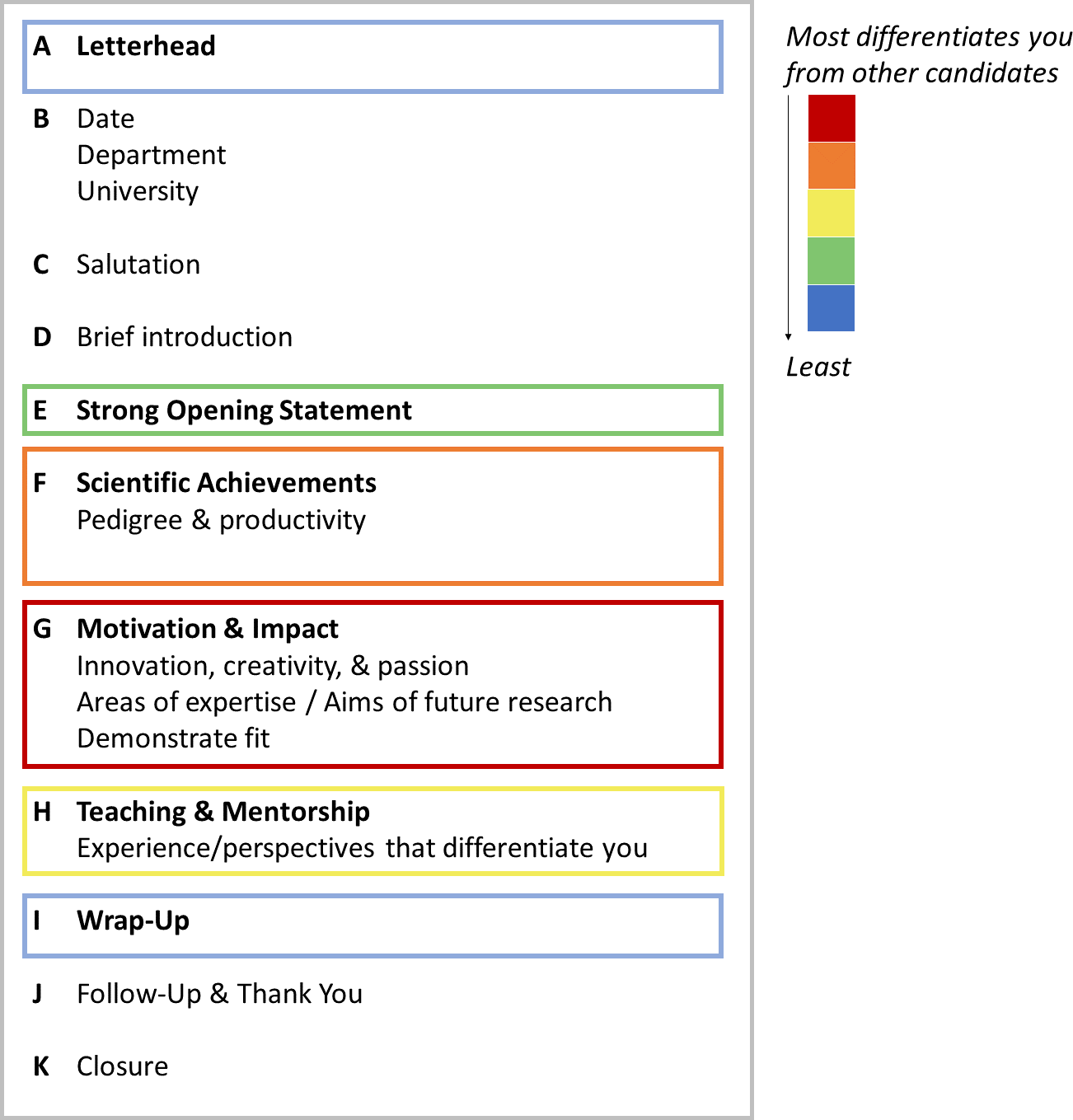
Source: MIT Broad Institute Communication Lab
Academic Cover Letter vs. CV: Understanding the Difference
This is one of the biggest sources of confusion. Your CV and your cover letter serve different purposes, and knowing the difference prevents you from wasting valuable letter space.
| Cover Letter |
CV |
| Narrative, storytelling format |
Bulleted, factual listing |
| 1-3 pages |
Can be 10+ pages |
| Explains the “why” behind your achievements |
Lists “what” you’ve done |
| Tailored to a specific position and institution |
Standard document for all applications |
| Connects research, teaching, and service |
Lists each category separately |
| Written in prose paragraphs |
Written in bullet points and sections |
The UNC Writing Center puts it well: the cover letter expands on your CV by providing context. Your CV might say “Published 5 peer-reviewed articles.” Your cover letter should say “My work on X was published in [Journal] because it challenged the prevailing assumption about Y — which aligns closely with Professor Smith’s research on Z.”
Who Should You Write For? Tailoring the Right Letter
Not all academic positions use the same cover letter framework. The structure changes significantly depending on what kind of job you’re applying for.
Faculty Positions (Tenure-Track)
Faculty positions are the most comprehensive. You need to cover research, teaching, and service. Penn Career Services notes that for humanities and social sciences, cover letters run 2–3 pages; for STEM, 1–2 pages.
The letter should address:
- Your current research trajectory (what you’ve done)
- Your future research agenda (what you plan to do)
- Your teaching experience and future course plans
- Your service commitments (committees, mentorship, outreach)
- Specific institutional fit (why this department)
Yale’s Office of Career Strategy emphasizes that faculty cover letters should demonstrate not just what you’ve done, but what you’ll bring to the department as a colleague. Think of yourself as a colleague already — not an applicant.
Postdoc Positions
Postdoc cover letters lean heavily on research fit. According to the University of Birmingham’s PGR guidance, you should “briefly introduce yourself and what attracted you to the employer and the job,” then focus on how your research interests align with the host lab.
Key elements:
- Brief personal introduction (name, current status, degree expected)
- Research summary and alignment with the host PI’s work
- Specific skills you bring (methods, techniques, datasets)
- Timeline and career trajectory after the postdoc
Research Scientist / Research Staff Positions
Earth Lab at CU Boulder explains that research position cover letters require a specific balance: “prove your expertise and passion while limiting jargon and dense language.” Hiring managers are busy and plowing through hundreds of applications — your cover letter should be concise, clear, and compelling.
The key differentiator for research positions vs. faculty positions is the reduced emphasis on teaching. Research positions focus almost entirely on your research capabilities, methodology, and how you’ll contribute to a specific project or lab.
The Cover Letter Structure (Step by Step)
Every academic cover letter, regardless of position type, follows this basic structure:
1. Letterhead and Contact Information
Start with your professional header. Include your name, current position, email, phone number, and links to your Google Scholar profile, LinkedIn, or academic website.
According to the MIT Communication Lab, your letterhead should include “critical contact information: name, degree, current position, email, and phone number” plus your professional profile page. This is your chance to establish credibility immediately.
Below that, include the date and the search committee’s contact information:
[Your Name], PhD
[Your Position], [Your Institution]
[email] | [phone] | [Google Scholar / website]
[Date]
[Faculty Search Committee Chair’s Name]
[Full Department Name]
[Institution Name]
[Department Address]
2. Salutation
Never use “Dear Sir/Ma’am” or “To Whom It May Concern.” The Earth Lab at CU Boulder is explicit about this: generic greetings stamp “I didn’t bother to research this company at all” across your application.
Instead, find the search committee chair’s name. LinkedIn, department directories, and the job posting itself are your tools. Use “Dear Dr. [Last Name],” or “Dear Members of the Faculty Search Committee,” if you cannot find a specific name.
3. The Opening Paragraph: Your Hook
This is where most applicants fail. Your opening should be specific, enthusiastic, and tailored. According to Penn Career Services, the first paragraph is where you state the position you’re applying for and make your case for why you’re interested in this specific department.
A strong opening template:
I am writing to apply for the [Position Title] in the Department of [Department Name] at [Institution Name]. I will defend my dissertation on [Topic] in [Month, Year], and my research on [brief description] aligns closely with the department’s focus on [specific area].
Notice how it includes: (1) the position, (2) institutional fit, and (3) a specific research connection. This is not generic.
4. Research Summary: What You’ve Done
This section bridges your CV and your research statement. The MIT Communication Lab advises: “Summarize successes highlighted in your CV that demonstrate the breadth and depth of scientific expertise. Demonstrate your productivity, as well as key scientific or technical strengths, with supporting details.”
The UNC Writing Center adds a crucial tip: “Consider mentioning your research questions, methods, key findings, as well as where and when you published and/or presented this work.”
Quantify your impact: number of publications, fellowships, collaborations, and presentations. Use active verbs (“led,” “developed,” “innovated”) rather than passive language (“participated,” “was involved”).
5. Future Research Plans: What You’ll Do
This is the hardest paragraph to write — and the most important for demonstrating independence. Yale’s Office of Career Strategy recommends: “Include specific questions you plan to pursue and how your work will evolve, and connect your future research to the department.”
Show that you’re thinking like a Principal Investigator, not just a graduate student. Mention:
- Specific aims of your next 3–5 year research plan
- Potential funding sources (grants you plan to apply for)
- How your research complements existing department strengths
6. Teaching Experience: Your Classroom Value
For faculty positions, teaching is a non-negotiable section. Even if your role is primarily research-based, search committees want to know you can teach.
Yale advises: “Highlight your teaching philosophy, experience, and any innovative teaching methods you’ve used in a way that highlights your effectiveness and enthusiasm as an educator. Mention specific courses you have taught or assisted with.”
The UNC Writing Center also emphasizes connecting teaching and research: “If you research the rise of feminism in the 19th century, consider how you bring either the methodology or the content of your research into the classroom.”
7. Institutional Fit: Why Them?
This is where most applicants waste an opportunity by writing generic praise. Instead, demonstrate real knowledge of the department:
- Mention 1–2 specific faculty members you’d like to collaborate with
- Reference research centers, labs, or programs that align with your work
- Note how your skills fill a gap in the department’s portfolio
MIT’s Communication Lab recommends: “Carefully consider research centers, core facilities, affiliated institutes or medical centers at the university. In many cases, campus- or state-wide research initiatives may complement your research program.”
8. The Closing Paragraph
Keep it professional, grateful, and forward-looking. The UNC Writing Center model is a reliable template:
Thank you for your time and consideration. Additional application materials are enclosed. Please feel free to contact me if supplemental information is required. I look forward to hearing from you.
Close with “Sincerely” or “Kind regards,” followed by your full name and credentials.
Common Mistakes to Avoid
These mistakes appear consistently across university career guides. Avoid them:
Generic content: The single biggest reason academic cover letters fail. Penn Career Services explicitly warns against sending the same letter to multiple departments. Every letter should reference specific faculty, labs, or programs unique to that institution.
Excessive jargon: The UNC Writing Center notes that “many committees have at least one member from outside their department.” Write for an intelligent non-specialist. The Earth Lab at CU Boulder echoes this: “Even if [the hiring manager] is an expert, you cannot assume that they have the exact same linguistic and educational background as you.”
Overly long letters: MIT recommends 1–2 pages maximum. Penn notes 2–3 pages for humanities, 1–2 for STEM. If your letter exceeds 3 pages, you’ve made it too long.
Repeating your CV word-for-word: Your cover letter should connect the dots, not duplicate them. UNC advises: “Since the letter is a relatively short document, select examples of your research that really highlight who you are as a scholar.”
Grammatical errors: A single typo in the opening paragraph signals carelessness. The UNC Writing Center stresses: “Make sure to proofread your letter not just for grammar but also for content.”
Using the word “dissertation” too much: The UNC Writing Center warns that “Some search committee members may see the word ‘dissertation’ as a red flag that an applicant is too focused on their role as a graduate student.” Describe it as “current research” or “current research project” instead.
Writing for Different Position Types
Research-Intensive Faculty Position
Lead with research. The UNC Writing Center provides a research-focused template:
- Paragraph 1: Identify position, introduce yourself and research interests, connect to department
- Paragraph 2: Research to date (questions, methods, findings)
- Paragraph 3: Current project (funding, key findings)
- Paragraph 4: Future research plans and goals
- Paragraph 5: Teaching experience and strategies
- Paragraph 6: Departmental connection and collaboration
- Paragraph 7: Thank you and next steps
Teaching-Intensive Faculty Position
Lead with teaching. Flip the template:
- Paragraph 1: Identify position, introduce yourself, connect interests to department
- Paragraph 2: Teaching experience and pedagogical commitments
- Paragraph 3: Student mentoring and community involvement
- Paragraph 4: Current research interests and how they relate to teaching
- Paragraph 5: Future research plans
- Paragraph 6: Departmental connection
- Paragraph 7: Thank you and next steps
Postdoc / Research Staff Position
Focus almost entirely on research alignment:
- Paragraph 1: Introduction, position, brief research background
- Paragraph 2: How your skills and experience align with the host lab’s work
- Paragraph 3: Specific techniques/methods you bring
- Paragraph 4: Future research plans and career trajectory
- Paragraph 5: Closing
Your Step-by-Step Writing Process
The UNC Writing Center describes this as a process that “may be as short as a few hours or as long as several weeks.” Here’s a practical workflow:
- Research the institution: Read the job posting carefully. Note specific requirements, courses the department offers, and faculty research areas.
- Research the department: What’s their core strength? What gaps exist? What courses do they offer?
- Brainstorm: Create a list of your experiences that relate to the job. Don’t filter yet — dump everything relevant.
- Prioritize: Select 3-4 strongest examples per section. Discard anything irrelevant.
- Draft: Write the opening first (it’s the hardest part). Then fill in research, teaching, and fit sections.
- Revise: Step away from the letter for a few hours, then read it again. Give it to a friend in your field AND someone outside your field for clarity feedback.
Penn Career Services adds a crucial step: “Speak to faculty in your department to get a sense of what is expected in cover letters in your field. See if any faculty you know have been involved in search committees, and find out what they looked for in cover letters.”
Before You Submit: The Quality Checklist
The MIT Communication Lab’s criteria for success is an excellent checklist:
- Demonstrate scientific/scholarly accomplishments and achievements
- Clearly define the vision and impact of your future research program
- Differentiate yourself from colleagues, including your advisors and other candidates
- Establish what your niche will be in the department
- Clearly display excitement and passion
- Keep the cover letter to 1–2 pages (or 2–3 for humanities)
UNC adds these content checks:
- Did you mention specific faculty, labs, or programs unique to this institution?
- Is the jargon minimized for a broad academic audience?
- Are achievements quantified with evidence (publications, grants, teaching evaluations)?
- Is the letter tailored to this specific position (not copied from another application)?
- Is the tone confident but not arrogant?
- Have you proofread for spelling, grammar, and formatting errors?
The Bottom Line
An academic cover letter is your most persuasive tool in the application process. It’s where you tell the story that your CV can’t: why your research matters, why you teach the way you do, and why you belong in this specific department.
The difference between a good cover letter and a great one always comes down to specificity. Generic praise gets generic responses. Specific knowledge of the department, specific connections between your work and theirs, and specific examples of how you’ll contribute — that’s what moves applications forward.
Related Guides
Need help writing your academic cover letter? Our expert native English writers can craft a tailored, professional cover letter that highlights your unique strengths and aligns perfectly with the position. Request a consultation for editing and writing support.
